
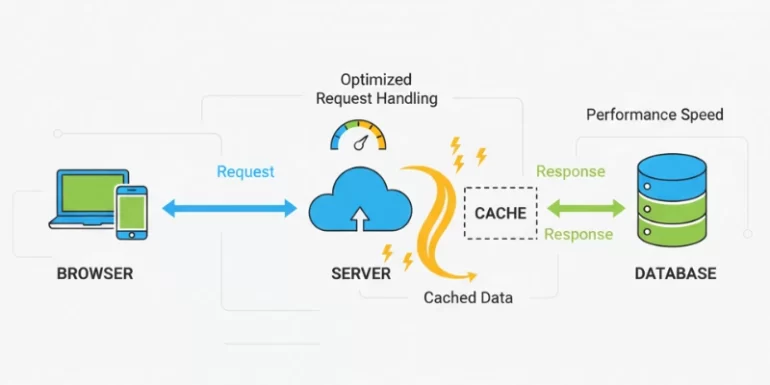
Caching is one of the most important performance concepts in modern web applications. At its core, caching is about storing frequently used data in a temporary location so it can be retrieved faster the next time it is needed. Instead of repeatedly processing the same request or fetching the same data from a slow source, a cached response helps reduce delay and improve user experience.
This concept becomes especially valuable as applications grow in complexity and traffic. Learners who want to understand performance at a deeper level can consider enrolling in a Full Stack Developer Course in Trivandrum at FITA Academy to gain structured guidance along with practical insights into real-world systems.
Why Caching Matters in Web Applications
Every web application handles requests that consume time and resources. Without caching, the server must repeat the same operations for identical requests. This increases response time and puts unnecessary pressure on backend systems. Caching reduces this load by serving stored results instead of recalculating them. Faster responses lead to better user satisfaction and improved reliability. Caching also helps applications handle traffic spikes more smoothly.
By reducing repeated database queries and heavy computations, caching allows systems to scale more efficiently. Developers who master this concept can design applications that feel responsive even under high demand. To explore more about performance topics alongside backend fundamentals, taking a Full Stack Developer Course in Kochi can provide hands-on experience and a deep theoretical knowledge.
Different Layers Where Caching Happens
Caching is not limited to a single layer of an application. It can exist in the browser, on the server, or even within databases. Web browser caching saves files such as images and stylesheets on the user’s device, minimizing the need for repeated downloads. Server-side caching stores processed responses or frequently accessed data. Database-level caching helps minimize expensive query execution.
Each layer serves a unique purpose, and together they create a smoother user experience. Understanding where to cache and what to cache is more important than simply adding caching everywhere. You can explore this balanced approach in backend and system design by enrolling in a Full Stack Developer Course in Pune to build a strong understanding of application performance.
What Makes a Good Caching Strategy
An effective caching strategy focuses on freshness, consistency, and relevance. Cached data should remain useful without becoming outdated. Developers must decide how long data should stay in cache and when it should be refreshed or removed. Over-caching can lead to stale information, while under-caching can reduce performance benefits.
The goal is to cache data that is read often but changes infrequently. A thoughtful strategy improves speed without compromising accuracy. Learning these decision-making skills helps developers think beyond code and into system behavior, which is a key transition from beginner to professional-level development.
Common Challenges with Caching
Caching introduces its own set of challenges. One major concern is cache invalidation, which involves deciding when cached data should be cleared or updated. Another challenge is increased memory usage, since cached data occupies space. Developers must also handle edge cases where cached responses may not reflect recent updates. Despite these challenges, caching remains essential because its benefits far outweigh its complexity when implemented thoughtfully. Understanding these tradeoffs prepares developers to design systems that remain fast and reliable over time.
Caching fundamentals play a critical role in building efficient and scalable web applications. By reducing response times, lowering server load, and improving user experience, caching becomes a cornerstone of performance optimization.
Developers who understand caching can make smarter architectural choices and avoid common pitfalls as applications grow. Strengthening these concepts through guided learning helps bridge theory and practice. To enhance your skills, consider signing up for a Full Stack Developer Course in Dindigul to gain clarity, confidence, and practical exposure in real-world development scenarios.
Also check: Scaling Full-Stack Apps for High Traffic